
Map the business event
We start with the event that matters. An accepted order, approved form or paid invoice may need to create records, notify staff and update another system. The correct sequence depends on the business process and the information available at each stage.
For an illustrative order workflow, payment confirmation and an order-status change are different events. Treating them as interchangeable can create duplicate work or tell a customer something that has not happened.
Choose the integration route
An API may be the best route, but not every useful system provides one. Depending on permissions and vendor support, the options may include webhooks, scheduled exports, file exchange or controlled database access.
We check the actual documentation, access model, data formats, usage limits and test environment. A vendor logo on a proposal does not prove that the required operation is available through its interface.
Make failure handling part of the design
- Define the authoritative system for each important field.
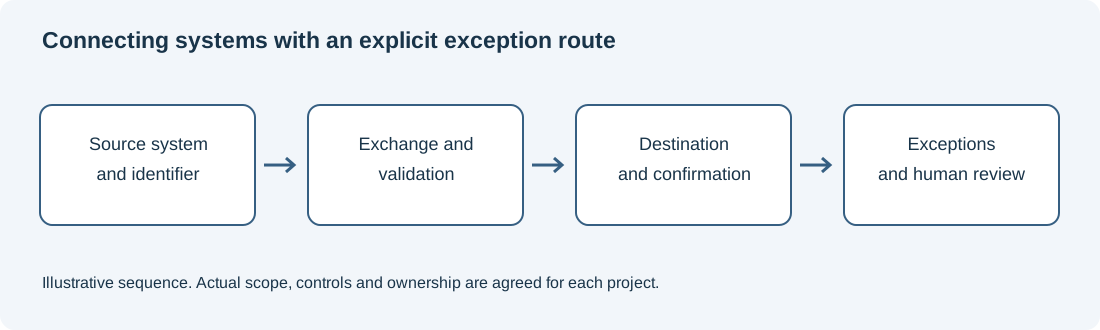
- Map identifiers and validation rules between systems.
- Handle duplicate events and repeated requests deliberately.
- Decide which failures can be retried and which need a person.
- Record progress without exposing sensitive data in logs.
- Make unresolved exceptions visible to the team responsible.
A successful test with one record is a starting point, not a complete operational design.
Security and change control
Access should be limited to what the integration needs. We agree where credentials are held, who can rotate them and how production and test access differ. Data minimisation and retention decisions should be made alongside the business process.
External interfaces can change. The handover should identify dependencies, owners, monitoring and the checks required after a vendor update. The integration needs a maintenance route, not just an initial delivery date.
What we deliver
A scoped integration can include the data-flow design, field mapping, implementation, acceptance checks and an operational handover. Ownership of code, accounts and third-party charges is stated in the proposal.
Naxtech’s developed products provide examples of systems involving ordering and customer-feedback workflows. For your project, send both system names, the required events, example records and current vendor access. We will identify the constraints before promising a connection.
Common questions
Can systems without an API be connected?
Sometimes. Export/import, supported database access or another vendor-approved route may work. Feasibility and reliability need assessing rather than assuming an API is essential.
What happens if a system is unavailable?
The design should define whether work is queued, retried, rejected or passed to staff. The correct choice depends on the business consequence of delay or duplication.
Who pays for API subscriptions?
Third-party plans and usage costs should be identified before implementation and assigned to the appropriate account owner. They are separate from the cost of development.